Two small parts of a conveyor line do outsized work: cleaners keep the belt clean after discharge, and impact beds cushion the belt where material lands. Both sit at the ends of the loaded run, one at the discharge end and one at the loading point, and both protect the belt, the rollers and the structures around them. The company website lists primary and secondary conveyor belt cleaners and the impact bed for belt conveyors under its conveyor parts category, and this guide explains those parts in plain terms, using only the category names and descriptions published on the company website, so that an inquiry can name the right cleaning and cushioning arrangement.
Primary cleaners remove carryback at the head pulley
Primary conveyor belt cleaners are described on the company website as designed to remove bulk material carryback from the conveyor belt as it passes over the head pulley. Carryback is the material that clings to the belt after discharge instead of leaving at the head pulley, and it matters because it rides back along the return strand, drops off where it is not wanted, fouls return rollers and adds wear to the whole line. A primary cleaner sits at the head pulley itself, where the belt turns around, and scrapes or presses against the belt at the point where carryback is thickest. The briefing questions for a primary cleaner start with the material: what clings to the belt, how wet or sticky is it, and how much of it returns past the head pulley? A dry, free-flowing material may leave the belt cleanly, while a wet, fine material may cling stubbornly, and the cleaner arrangement must suit the material actually carried.
The head pulley itself is part of this story. A cleaner that presses too hard wears the belt; a cleaner that presses too lightly leaves carryback behind. The balance depends on the belt, the material and the discharge arrangement, which is why the cleaner, the head pulley and the discharge should be briefed together rather than as separate purchases. Describe the discharge end honestly, including whether carryback is already a problem and where the returned material ends up, so the supplier can judge how aggressive the cleaning needs to be.
Secondary cleaners remove the fine residue that remains
Secondary conveyor belt cleaners are described on the company website as designed to remove fine residual material that remains on the belt after the primary cleaner has done its job. The distinction is one of stages: the primary cleaner takes the bulk of the carryback at the head pulley, and the secondary cleaner, mounted further along the return strand, takes the fine film that the primary cleaner leaves. That second stage matters because fine residue is the material most likely to build up on return rollers, cause belt wander and grind into the belt surface over time. A line that runs clean with a primary cleaner alone may still benefit from a secondary cleaner if the material is fine or sticky, and a line that already shows return-strand build-up is telling its owner that one stage is not enough.
The briefing questions for secondary cleaning are about the return strand. How clean does the belt return today, and where does residue collect? Does the return strand run indoors, where spilled residue fouls the floor, or outdoors, where it blows away? Is the belt itself smooth or textured, and does the texture hold fine material? Those answers decide whether a secondary cleaner is needed, where it should sit, and how it should be maintained, because a cleaner that cannot be reached for adjustment and blade changes will soon stop cleaning.
Impact beds cushion the belt at the loading point
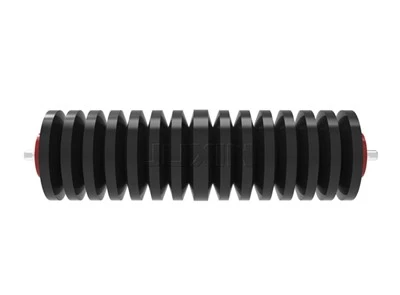
The impact bed for belt conveyors sits where material lands on the belt, and its job is the same as the impact rollers covered in the idler guide: absorbing the shock of falling material so the belt and its supports are not punished by every drop. The difference is one of form. Where impact rollers cushion with individual rollers, an impact bed presents a continuous supported surface under the belt at the loading zone, which spreads the load and supports the belt across the full width of the impact area. That continuous support suits loading points where the material is heavy, where the drop is high, or where the belt has suffered damage at the loading zone before. The briefing questions are the same as for impact rollers, with one addition: how wide and how long is the loading zone, and does the feed stay in one place or move along the belt?
Impact beds and impact rollers are often used together rather than as alternatives, and the combination should be briefed as one loading-zone arrangement. Describe the feed: what material falls, from what arrangement, in what quantities, and whether the feed is steady or surging. Describe the belt at the loading point: does it show impact damage, and does spillage escape at the loading zone? Those two descriptions let the supplier judge whether rollers alone, a bed alone, or a combined arrangement suits the loading point.
Cleaning, cushioning and the rest of the line
Cleaners and impact beds are sometimes treated as accessories, but they protect every other part of the line. A belt that returns dirty wears its return rollers faster and tracks worse; a belt that is punished at the loading point fails sooner and costs more in downtime than the cushioning that would have protected it. The conveyor hood covers and stringer frames in the same parts category complete the picture: hoods contain dust and protect the belt from weather, and stringer frames provide the structural support the belt runs on. A buyer planning cleaning and cushioning should think about the loading zone and the discharge end as one pair of ends, because material behaviour at one end predicts behaviour at the other: a sticky material that needs strong cleaning at discharge probably also needs careful cushioning at loading, and a dusty material that needs hoods probably also needs cleaning that keeps dust off the return strand.
Questions to put in a cleaner and impact bed inquiry
Please confirm the minimum order quantity with the supplier before placing an order. Please confirm the lead time with the supplier before placing an order. Certificates available upon request. The questions below belong in an inquiry, and the answers should come from the supplier for the specific line, not from this guide. Name the cleaner or impact bed arrangement you have in mind, and describe the material, the loading and discharge arrangements, and the belt. Say whether carryback or loading-zone damage is already a problem, where residue collects, and whether the line runs indoors or outdoors. Ask the supplier to confirm which cleaner stages and which impact arrangement suit that line, how the parts match existing pulleys, frames and belts, and what spares and wearing parts to hold. When a certificate matters for the project, name it in the inquiry and ask the supplier to confirm its scope and validity before ordering.
Related reading on this site
Cleaning and cushioning sit at the ends of the loaded run, so the companion guides explain the parts they protect. The guide to conveyor idler types explains impact rollers and return rollers in detail. The guide to conveyor pulley types explains the head pulley where primary cleaning happens. The guide to belt conveyors for mining and tunnelling shows the routes these parts serve. The Conveyor Parts category page lists the full family, and the inquiry page is where the brief goes.