Mining and tunnelling put belt conveyors through their hardest work. Underground, a conveyor must haul ore or coal along confined routes, often on gradients and around curves, while dust, moisture and abrasive material punish the belt and its supports. On the surface, the same line must cross long distances, climb out of a pit or a portal, and deliver its load to a plant or a stockpile. The company website lists its belt conveyor line under one category, with mining conveyors, coal conveyors, tunnel systems and long-distance pipe conveyors among the names, and this guide explains those types in plain terms, using only the category names, descriptions and industry words published on the company website.
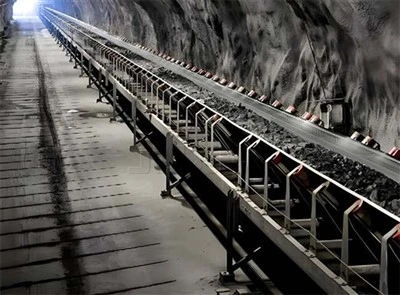
Mining conveyors haul ore underground and outdoors
Mining conveyors are described on the company website as built for safe, continuous underground ore haulage, and the mine conveyor is described as engineered for abrasive ore and steep underground haulage. Those two descriptions capture the underground brief: the material is abrasive, the route is steep and confined, and the line must run continuously because the mine depends on it. A buyer briefing a mining conveyor should describe the ore, the route and the gradient, and should say whether the line runs underground, outdoors or both, because the two environments ask different things of the belt, the supports and the covers. Underground lines need attention to dust, ventilation and access for maintenance in confined space; outdoor lines need attention to weather, dust containment and long exposed runs. The same conveyor name covers both, so the route description is what makes the brief checkable.
The belt conveyor category also lists underground mining conveyor systems as a group, and a mining conveyor belt system as a related name. The useful distinction for a buyer is between a single conveyor and a system: a system links several conveyors, transfer points and structures into one route from the working face to the surface or the plant. Briefing a system means describing the whole route, including transfer points, rather than one conveyor in isolation, because the transfers are where material is most likely to spill, block or wear the belt.
Coal conveyors handle fuel from face to plant
Coal belt conveyors are described on the company website as built flame-retardant for safe, continuous coal haulage, and the coal handling conveyor system is described as built flame-retardant for underground-to-plant coal haulage. The repeated word in both descriptions is flame-retardant, which reflects the fire risk that coal dust and coal handling carry, especially underground. A buyer briefing a coal conveyor should describe the coal, the route from face to plant, and the fire and dust controls already in place, and should ask the supplier to confirm which belt and system features suit that fire risk. The coal transfer conveyor in the same category covers the shorter links between stages of a coal route, and the same fire and dust questions apply at every transfer, because a transfer point concentrates dust and spillage.
Coal routes also illustrate why the discharge and loading ends deserve as much attention as the conveyor itself. Coal is loaded at the face, transferred between conveyors, and discharged at the plant, and each of those points needs its own arrangement. The guides to idler types and to belt cleaners and impact beds cover the loading and discharge ends in more detail, and they are worth reading alongside this guide before a coal route is briefed.
Tunnel conveyors remove muck as the bore advances
Tunnel conveyor systems are described on the company website as built with extensible frames, dual safety brakes and flexible curve tracking for underground bores, and that description captures a special duty: a tunnel conveyor must grow as the tunnel advances, must follow curves in the bore, and must stop safely when required. The extensible frame lets the conveyor lengthen without rebuilding the line; the curve tracking lets it follow the bore alignment; the safety brakes hold the line when it stops. A buyer briefing a tunnel conveyor should describe the bore, the advance rate, the muck being removed and the curve alignment, because those four facts decide the conveyor arrangement more than any catalogue name. The company website also lists a continuous muck removal belt conveyor system for highway mountain tunnels among its solution captions, which shows the same duty on civil tunnelling work as well as mining work.
Hooded conveyors belong in this conversation too. The company website describes hooded conveyors as delivering weather protection and superior dust containment, which matters wherever a conveyor runs outdoors or where dust must be kept in. A tunnel portal, where a conveyor leaves the bore and runs outdoors, is exactly the place where a hooded section earns its keep, and a buyer should describe the portal and the outdoor run together with the underground section.
Long-distance pipe conveyors enclose the load
Long-distance pipe conveyors and pipe conveyor systems enclose the belt into a tube, which keeps the material inside and the weather outside. The company website describes the long-distance pipe conveyor as delivering enclosed bulk transport safely, and the pipe conveyor system as building enclosed systems for cement, ports, chemicals, metallurgy and power industries. Enclosure suits routes that cross sensitive ground, routes with tight curves, and materials that must not spill or blow away. The briefing questions for a pipe conveyor are about the route and the material: how long is the route, how does it curve, what material travels inside, and where does the pipe open for loading and discharge? An enclosed route hides its load, which is an advantage for containment but means inspection and maintenance access must be planned explicitly rather than assumed.
The long-distance conveyor belt system in the same category covers open long routes as well, and the choice between an open and an enclosed long route is a route question, not a product preference. Describe the ground the route crosses, the neighbours it passes, the curves it follows and the material it carries, and let the supplier confirm which arrangement suits that route.
Questions to put in a mining or tunnelling inquiry
Please confirm the minimum order quantity with the supplier before placing an order. Please confirm the lead time with the supplier before placing an order. Certificates available upon request. The questions below belong in an inquiry, and the answers should come from the supplier for the specific route, not from this guide. Name the conveyor type you have in mind, and describe the material, the route, the gradient, the curves and the environment, underground and outdoors. Say whether the line runs continuously or intermittently, how material is loaded and discharged, and what fire, dust and maintenance arrangements already exist. Ask the supplier to confirm which conveyor type suits that route, how transfer points are arranged, what covers and enclosures are offered, and what spares and wearing parts to hold. When a certificate matters for the project, name it in the inquiry and ask the supplier to confirm its scope and validity before ordering.
Related reading on this site
Mining and tunnelling routes use the whole line, so the companion guides fill in the details. The guide to conveyor idler types explains the rollers that support the belt along the route. The guide to stacker conveyor stockpiling covers what happens when the route ends at a yard. The guide to bulk material handling system selection shows how a mining or tunnelling route is briefed as one system. The Belt Conveyors category page lists the full family, and the inquiry page is where the brief goes.