A stockpile is where a bulk handling line pauses: material arrives by conveyor and has to be stored in a yard until it is needed, and the stacker is the machine that builds that pile. The company website lists its stacker line under one category, and the names there describe different ways of moving and placing material: tracked machines that travel on their own, radial machines that sweep an arc, telescopic machines that reach further as the pile grows, and portable machines that move between jobs. This guide explains those types in plain terms, using only the category names, descriptions and material lists published on the company website, so that a yard plan can be briefed with the right questions.
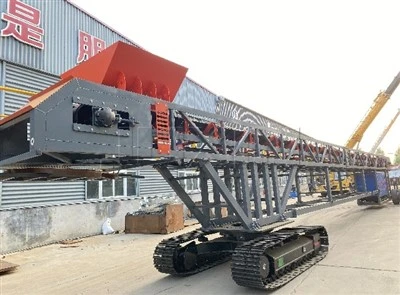
Tracked stackers move the pile without fixed rails
The tracked stacker conveyor is described on the company website as a highly versatile and durable material handling system designed for bulk material stacking and transportation, and the tracked radial stacker is described as a high-performance, mobile system designed to create efficient and large stockpiles. The word that matters in both names is tracked: the machine travels on tracks rather than on fixed rails or wheels alone, which means it can reposition around a yard and build piles in different places without new civil work. That mobility suits yards where the pile location changes, where several piles are worked in rotation, or where the ground layout is still evolving. The questions to ask about a tracked stacker start with the yard itself: how large is the working area, what surface does the machine travel on, and how often does the pile location change? A tracked machine earns its keep where movement is frequent; on a yard with one fixed pile position, a simpler arrangement may serve just as well.
Portable tracked conveyors and wheeled conveyors extend the same idea toward smaller, faster moves. The company website notes all-terrain mobility for its portable tracked conveyor and rapid off-grid mobility for its wheeled conveyor, which points to jobs away from fixed infrastructure: temporary yards, remote sites and seasonal work. A buyer considering portable equipment should describe the site honestly, including access, ground conditions and power availability, because mobility only helps if the machine can actually reach the working face and run there.
Radial stackers sweep an arc to build wide piles
A radial stacker conveyor is described on the company website as a highly versatile system designed for stockpiling operations in industries such as mining, aggregates and construction, and the radial telescopic stacker is described as a versatile, high-performance system designed to handle bulk material stacking with precise control and flexibility. Radial machines pivot around a fixed point and sweep an arc, so one machine can build a long, wide pile or several piles arranged along that arc. That geometry suits yards that need volume without moving the machine for every pile, and it suits blending work where material from different sources is laid down in layers. The radial stacking conveyor is described as maximising yard storage across a full sweep, and the linear stacker is described as automating longitudinal blending and modular retreat transfer, which shows how the same radial idea extends into blending and reclaiming as well as simple stacking.
The yard question for a radial machine is shape. How wide is the yard, and how is material reclaimed from the pile? A radial pile is easy to build but must also be easy to reclaim, and the reclaim method decides whether the pile shape helps or hinders the next step. Describe the yard dimensions, the reclaim equipment and the way material leaves the pile, so the supplier can check whether a radial arrangement suits the whole cycle or only the stacking half of it.
Telescopic stackers reach further as the pile grows
A telescopic stacker extends its conveyor as the pile grows, which lets one machine build a longer pile without moving its base. The towable telescoping conveyor in the same category adds mobility to that reach, so the machine can be towed to a new position and then extended again. Telescopic reach matters where the yard is long and narrow, where the pile must grow along one line, or where the discharge point has to stay clear of the pile face. The briefing questions are about length and height: how long must the pile run, how high must it rise, and what clearance does the discharge end need? Reach is not free; a longer extended conveyor asks more of its structure and its supports, so the pile dimensions and the material weight should be described together.
Transfer conveyor systems and track conveyor systems sit alongside the stackers in the same category and complete the picture. A transfer system links end to end to move bulk materials easily, which is how a stacker is fed from the main line, and track systems offer off-grid mobility and high-capacity transfer for sites without fixed infrastructure. A stacker inquiry should therefore describe the feed as well as the pile: where the material comes from, how it arrives at the stacker, and whether the feed conveyor already exists or is part of the same brief.
Materials named for stacker work
The company website names the materials its stacker category serves, and that list is a useful check for any buyer. Construction materials include aggregate, sand, clinker, crushed rocks, cement, asphalt and earth-moving materials. Mineral ores include coal, iron ore, copper ore, silver ore, bauxite and rare earth. Waste materials include slag, tailings, mulch, fly ash and construction waste. Grains include wheat, corn, soybeans and rapeseed. Agriculture includes fertilizer, biomass and topsoil. Other materials include bamboo, wood chips and sawdust. A buyer whose material appears on that list can brief with confidence that the category is relevant; a buyer whose material does not appear should say so plainly in the inquiry and ask the supplier to confirm suitability, rather than assuming that a stacker built for one material suits another. Material behaviour matters as much as material name: fine, dusty material behaves differently from lumpy, wet material, and the stacker, the feed and the pile shape all respond to that behaviour.
Questions to put in a stacker inquiry
Please confirm the minimum order quantity with the supplier before placing an order. Please confirm the lead time with the supplier before placing an order. Certificates available upon request. The questions below belong in an inquiry, and the answers should come from the supplier for the specific yard, not from this guide. Name the stacker type you have in mind, and describe the yard, the pile dimensions, the material and the way material is fed and reclaimed. Say whether the site is fixed or temporary, whether the pile location changes, and whether the machine must travel on tracks, wheels or a fixed base. Ask the supplier to confirm which stacker type suits that yard, how the feed conveyor connects, what ground and access the machine needs, and what spares and wearing parts to hold. When a certificate matters for the project, name it in the inquiry and ask the supplier to confirm its scope and validity before ordering.
Related reading on this site
Stackers are one family in a complete line, so the companion guides help complete the brief. The guide to conveyor idler types explains the rollers that support the belt feeding the stacker. The guide to bulk material handling system selection shows how stackers are briefed together with idlers, pulleys, belt conveyors and parts. The guide to conveyor pulley types covers the drive and return ends of the same line. The Stacker Conveyors category page lists the full family, and the inquiry page is where the brief goes.