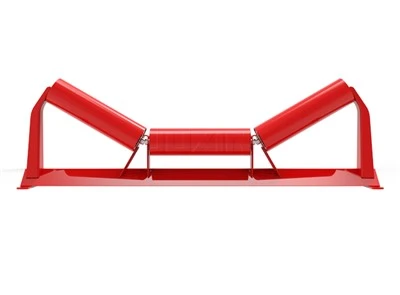
Conveyor Troughing Idlers is listed in the Idlers line of Hebei Juxin Conveyor Engineering Co., Ltd.. The company website describes it as follows: Belt conveyor troughing idlers are a type of conveyor idler that are designed to support the belt and prevent it from sagging in the middle. " That description is the starting point for this page. Everything else here explains, in plain terms, where such an " item sits on a working conveyor line, what kind of duty buyers usually ask about, and what to confirm in an inquiry " before any order is placed. No specification table is published here, and this page does not invent specifications.
What Conveyor Troughing Idlers does on the line
A troughing idler shapes the belt into a trough so loose material sits in the middle of the belt instead of spreading to the edges. That shape matters most on the loaded strand, where a flat belt would spill material at the sides and a sagging belt would strain the belt and the rollers. The trough is formed by the centre roller and the two wing rollers working together, so the set must be considered as a set, not as three separate rollers.
On a working line, the question is rarely the item alone. It is how the item behaves with the belt, the load and " the rest of the strand around it. A carrying component that runs true keeps the belt centred and the load moving. " A return or discharge component that does its job quietly keeps the return strand clean and the drive end free of " carryback. When you describe your line, describe the strand, the loading point and the discharge end together, so " the supplier can check fit against the whole arrangement rather than against a single part in isolation.
Where buyers ask about Conveyor Troughing Idlers
Troughing idlers are asked about wherever loose bulk material is carried on a belt, including mining, aggregate, chemical and port lines. They are the normal choice for the loaded strand on an overland or in-plant conveyor, and the trough shape and roller arrangement should be confirmed against the belt and the material being carried.
The industries named on the company website for bulk handling work are mining, tunnelling, aggregate, chemical, " port and metallurgy. Within those industries the same family name can cover very different duties, from a short " transfer run to a long overland route, so the industry name alone is not enough for a quotation. State the material " being handled, whether the run is indoor or outdoor, and whether the line stops and starts often or runs " continuously, and ask the supplier to confirm suitability for that duty in writing.
What to confirm before ordering Conveyor Troughing Idlers
Please confirm the minimum order quantity with the supplier before placing an order. Please confirm the lead time with the supplier before placing an order. Use the checklist below in your inquiry. Each point is a question to confirm with the supplier, not a specification published on this page, and no specification table is published for this item here.
- Trough shape and wing arrangement: confirm the trough arrangement offered for your belt and material, so the set matches your frames.
- Belt width and material: confirm the belt width and the material carried, including lump size where it matters for loading.
- Carrying load: confirm the load the loaded strand must support, so the supplier can confirm duty.
- Set quantity: confirm how many troughing sets the run needs, and confirm quantity and delivery in the inquiry.
Certificates available upon request. If a certificate matters for your project, ask for it by name in the inquiry so the supplier can confirm scope and validity before you order.
Inspection and spares for Conveyor Troughing Idlers
A troughing set should be inspected as a set, because the centre roller and the two wing rollers form the trough together. If one wing roller seizes or wears faster than the others, the trough becomes lopsided, the belt rides high on one side, and material spills from the low side on every pass. Check the wing rollers for free rotation and for wear on the shell, check the centre roller for a groove worn by the belt, and check the frame for a bent or twisted wing bracket that would hold one roller out of line. Look at the belt edges for fraying or wear that shows the belt has been running against a frame edge, and look at the ground under the run for spillage that marks where the trough has failed. Replace a whole troughing set when one roller in it has failed, and keep the old set for comparison so the next inspection can see whether the failure repeats in the same position.
Fitting Conveyor Troughing Idlers into an existing line
Fitting a troughing set starts with the belt and the frame it must match. Confirm the belt width first, because the trough width must suit the belt rather than the other way round, and confirm the frame type, since a troughing set for one frame will not necessarily sit correctly in another. Check the loading point upstream, because material dropped off centre will defeat even a well-fitted troughing set, and the loading chute may need attention at the same time as the idlers. If the line carries more than one material, state the heaviest and the most abrasive material in the inquiry, so the supplier can confirm duty for the worst case rather than for the average case. Ask for confirmation of the set arrangement offered, including how the wing rollers are held and how the set is removed for replacement, since a set that is hard to remove will be inspected less often.
Related lines for Conveyor Troughing Idlers
These lines are often briefed together. Follow the links to compare families before you enquire, " and keep the inquiry in one place so the supplier can check the parts as a set.
Brief this line for your project. Tell us the material, the route and the duty you expect, and we will confirm what can be supplied. Send an inquiry
Source note: product names and descriptions on this page follow the company website category pages. " No specification table is published here.