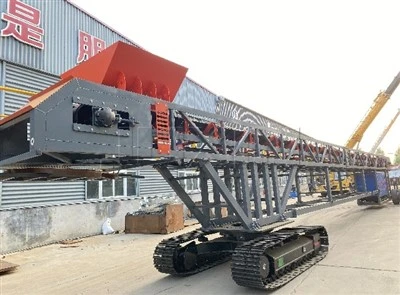
Tracked Stacker Conveyor is listed in the Stackers line of Hebei Juxin Conveyor Engineering Co., Ltd.. The company website describes it as follows: A tracked stacker conveyor is a highly versatile and durable material handling system designed for bulk material stacking and transportation. " That description is the starting point for this page. Everything else here explains, in plain terms, where such an " item sits on a working conveyor line, what kind of duty buyers usually ask about, and what to confirm in an inquiry " before any order is placed. No specification table is published here, and this page does not invent specifications.
What Tracked Stacker Conveyor does on the line
A tracked stacker conveyor moves on tracks, so it can be repositioned around a stockyard without a fixed foundation or a crane lift. That mobility is the point of the machine: it builds a stockpile where it stands, then moves to build the next one, and it can follow the work as the yard layout changes. For a yard that handles several materials or several piles, a tracked machine avoids the cost and delay of fixed structures for every pile.
On a working line, the question is rarely the item alone. It is how the item behaves with the belt, the load and " the rest of the strand around it. A carrying component that runs true keeps the belt centred and the load moving. " A return or discharge component that does its job quietly keeps the return strand clean and the drive end free of " carryback. When you describe your line, describe the strand, the loading point and the discharge end together, so " the supplier can check fit against the whole arrangement rather than against a single part in isolation.
Where buyers ask about Tracked Stacker Conveyor
Tracked stackers are asked about in aggregate yards, mining stockyards and port storage areas, where stockpiles are built, moved and reclaimed in turn. The materials named on the stackers category page include aggregate, sand, clinker, crushed rock, cement, coal and iron ore, and the inquiry should name the material and the pile shape you need.
The industries named on the company website for bulk handling work are mining, tunnelling, aggregate, chemical, " port and metallurgy. Within those industries the same family name can cover very different duties, from a short " transfer run to a long overland route, so the industry name alone is not enough for a quotation. State the material " being handled, whether the run is indoor or outdoor, and whether the line stops and starts often or runs " continuously, and ask the supplier to confirm suitability for that duty in writing.
What to confirm before ordering Tracked Stacker Conveyor
Please confirm the minimum order quantity with the supplier before placing an order. Please confirm the lead time with the supplier before placing an order. Use the checklist below in your inquiry. Each point is a question to confirm with the supplier, not a specification published on this page, and no specification table is published for this item here.
- Material and pile shape: confirm the material to be stacked and the pile shape and size you need.
- Ground and mobility: confirm the ground conditions and how far and how often the machine must move.
- Feed arrangement: confirm how material will be fed to the stacker, so the supplier can check the feed end.
- Delivery and commissioning: confirm delivery, installation and commissioning arrangements in the inquiry, and confirm quantity and delivery before ordering.
Certificates available upon request. If a certificate matters for your project, ask for it by name in the inquiry so the supplier can confirm scope and validity before you order.
Inspection and spares for Tracked Stacker Conveyor
A tracked stacker should be inspected around its tracks, its slew and its boom, because those three systems decide whether the machine can be positioned accurately and safely. Check track tension and track wear, look for damaged track shoes and for material packed in the track frames, and check the slew bearing for play and for smooth rotation through its full arc. Inspect the boom structure for cracks at welds and pivot points, and check the conveyor belt on the boom for wear, tracking and splice condition, since a boom belt failure stops the whole stacking operation. Keep a record of hours and of moves, because a tracked machine that moves often wears its tracks and slew faster than one that sits in one place, and the maintenance cycle should follow the moves rather than the calendar alone.
Fitting Tracked Stacker Conveyor into an existing line
Fitting a tracked stacker into a yard starts with the ground and the feed, not with the machine itself. Confirm the ground conditions, including soft spots and slopes, because a tracked machine needs firm, level ground to slew safely and to build an even pile. Confirm the feed arrangement, including how material arrives at the stacker and whether the feed conveyor must move with it, since a stacker that cannot be fed is just an expensive bridge. State the pile shape and size required, and ask the supplier to confirm the boom reach and slew range against your yard layout, including any height or access limits. Plan the travel routes between piles before the machine arrives, so the first move is a planned move rather than an improvisation across an unprepared yard.
Working checks for Tracked Stacker Conveyor
Planning the pile sequence is as important as planning any single pile, because a tracked machine builds several piles in turn and the order in which they are built decides how the yard is reclaimed. Start by naming the piles in the order they will be built, and state which material goes into each pile, so the machine moves through the yard in one planned sequence rather than back and forth between piles. Leave room between piles for the reclaim equipment to reach each pile without crossing a pile that is still being built, and mark the pile positions on the yard plan before the first pile is started, so the operator is not guessing where the next pile belongs. Plan the feed conveyor moves with the pile sequence, since the feed must follow the machine from pile to pile, and a feed move that was not planned holds up the whole yard. Finally, decide how each pile will be reclaimed before it is built, including the reclaim direction and the equipment that will do it, because a pile built without a reclaim plan is often a pile that cannot be used without rebuilding part of the yard around it.
Related lines for Tracked Stacker Conveyor
These lines are often briefed together. Follow the links to compare families before you enquire, " and keep the inquiry in one place so the supplier can check the parts as a set.
Brief this line for your project. Tell us the material, the route and the duty you expect, and we will confirm what can be supplied. Send an inquiry
Source note: product names and descriptions on this page follow the company website category pages. " No specification table is published here.