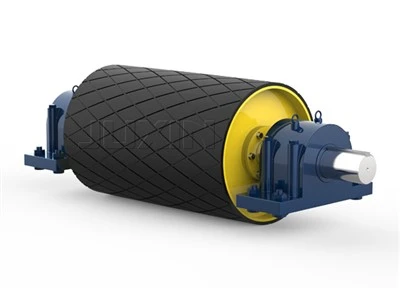
Conveyor Head Pulley is listed in the Pulleys line of Hebei Juxin Conveyor Engineering Co., Ltd.. The company website describes it as follows: A conveyor head pulley is located at the discharge end of the conveyor. " That description is the starting point for this page. Everything else here explains, in plain terms, where such an " item sits on a working conveyor line, what kind of duty buyers usually ask about, and what to confirm in an inquiry " before any order is placed. No specification table is published here, and this page does not invent specifications.
What Conveyor Head Pulley does on the line
A conveyor head pulley sits at the discharge end, where the belt turns and the material leaves the belt. It is usually the drive pulley as well, so it carries both the belt tension and the drive force, and it sets the discharge trajectory of the material. Because everything the line has carried passes over this pulley, its condition shows up quickly in belt tracking, discharge behaviour and drive performance.
On a working line, the question is rarely the item alone. It is how the item behaves with the belt, the load and " the rest of the strand around it. A carrying component that runs true keeps the belt centred and the load moving. " A return or discharge component that does its job quietly keeps the return strand clean and the drive end free of " carryback. When you describe your line, describe the strand, the loading point and the discharge end together, so " the supplier can check fit against the whole arrangement rather than against a single part in isolation.
Where buyers ask about Conveyor Head Pulley
Head pulleys are asked about on every belt conveyor line, in mining, aggregate, chemical, port and metallurgy work. They are often replaced or refurbished when a line is upgraded, and the inquiry should describe the discharge end, the drive arrangement and the belt before any quotation.
The industries named on the company website for bulk handling work are mining, tunnelling, aggregate, chemical, " port and metallurgy. Within those industries the same family name can cover very different duties, from a short " transfer run to a long overland route, so the industry name alone is not enough for a quotation. State the material " being handled, whether the run is indoor or outdoor, and whether the line stops and starts often or runs " continuously, and ask the supplier to confirm suitability for that duty in writing.
What to confirm before ordering Conveyor Head Pulley
Please confirm the minimum order quantity with the supplier before placing an order. Please confirm the lead time with the supplier before placing an order. Use the checklist below in your inquiry. Each point is a question to confirm with the supplier, not a specification published on this page, and no specification table is published for this item here.
- Discharge end and drive: confirm the discharge arrangement and whether this pulley is the drive pulley on your line.
- Belt width and tension: confirm the belt width and the tension the pulley must carry.
- Lagging need: confirm whether lagging is needed for your belt and drive conditions, and what lagging is offered.
- Shaft and bearing arrangement: confirm the shaft and bearing arrangement, so the pulley fits your existing structure.
Certificates available upon request. If a certificate matters for your project, ask for it by name in the inquiry so the supplier can confirm scope and validity before you order.
Inspection and spares for Conveyor Head Pulley
A head pulley should be inspected at the discharge end, where wear shows first. Check the shell for wear, grooving and damage, look at the lagging, where fitted, for wear, peeling and missing sections, and check the shaft and bearings for play, heat and noise during operation. Look at the discharge chute for wear and build-up, because a worn chute changes the discharge trajectory and can throw material back onto the return belt. Inspect the belt splice area as it passes the head pulley, since a splice that is failing often shows up first at the pulley where the belt bends most sharply. Record pulley condition at each planned stop, because a head pulley that wears gradually is easy to miss until it damages the belt, and a record makes the gradual change visible.
Fitting Conveyor Head Pulley into an existing line
Fitting a head pulley means fitting the drive end as a set. Confirm whether this pulley is the drive pulley on your line, and if so, confirm the drive arrangement, including the motor and gearbox position, so the new pulley aligns with the drive rather than fighting it. Confirm the belt width and the tension the pulley must carry, and confirm the shaft and bearing arrangement against your existing structure, since a pulley that does not fit its bearings and plummer blocks cannot be made to fit by force. State the discharge arrangement, including the chute and any downstream equipment, and ask the supplier to confirm the pulley, including any lagging, against that arrangement. If lagging is fitted, ask how it is inspected and replaced, because a lagging decision made at purchase decides maintenance for the life of the pulley.
Working checks for Conveyor Head Pulley
The discharge end deserves attention beyond the pulley itself, because the trajectory of material leaving the belt decides whether the downstream equipment works or wears out early. Watch the discharge stream during operation and look for material hitting the chute in one place, which wears a hole in that spot, or scattering beyond the chute, which shows the trajectory has changed since the pulley or belt was last changed. Check the chute lining for wear and for build-up, since a lined chute that has worn through behaves differently from a new one, and check the belt splice as it passes the head pulley for lifting edges that catch on the chute or on cleaners. If the discharge point feeds a stockpile, check the pile shape as well, because a changing pile shape often means the discharge trajectory has changed before any instrument shows it.
Related lines for Conveyor Head Pulley
These lines are often briefed together. Follow the links to compare families before you enquire, " and keep the inquiry in one place so the supplier can check the parts as a set.
Brief this line for your project. Tell us the material, the route and the duty you expect, and we will confirm what can be supplied. Send an inquiry
Source note: product names and descriptions on this page follow the company website category pages. " No specification table is published here.