Pulleys are the turning points of a belt conveyor. The belt wraps around them at the discharge end, at the tail end, at bends and at tensioning points, and each pulley has a different job depending on where it sits. The company website lists its pulley line under one category, and the names there already describe position and function: head pulleys at the discharge end, tail drums at the loading end, snub pulleys near the drive, wing pulleys that scrape the return belt, and lagging that improves grip. This guide explains each type in plain terms, using only the category names and descriptions published on the company website, so that an inquiry can name the right pulley instead of asking for a pulley in general.
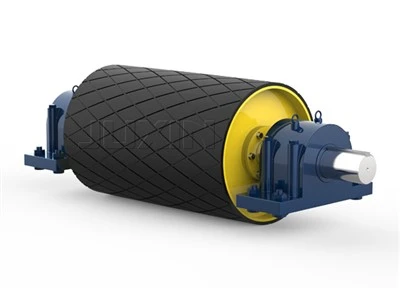
Head pulleys drive and discharge the belt
The conveyor head pulley is described on the company website as located at the discharge end of the conveyor, and that position defines its job. The head pulley is where the belt turns around and the load leaves, and on a driven line it is also where power enters the belt. A buyer briefing a head pulley should describe the discharge arrangement first: where the material leaves, how it is collected, and whether the discharge point is fixed or must move. The head drive pulley is listed alongside the head pulley in the same category, and the distinction between a driven head pulley and a non-driven one is exactly the kind of detail an inquiry should settle, because it decides the drive arrangement for the whole line. Describe the drive, the discharge and the duty together, and let the supplier confirm which head arrangement suits them.
Tail drums and tail drum pulleys sit at the opposite end. The company website describes the tail drum pulley as ensuring precise belt tracking and extended system life, and the conveyor tail drum as located at the end of the conveyor and often mounted on a tensioning device. The tail end is where the belt starts its loaded run, so tracking there decides tracking everywhere else: a belt that starts crooked stays crooked. A buyer troubled by tracking should look at the tail end first and describe what happens there, including how the belt is loaded and whether the tail arrangement allows adjustment.
Deflection and snub pulleys shape the belt path
Not every pulley drives or discharges; some exist to shape the path the belt takes. The deflection pulley in belt conveyors is described on the company website as directing conveyor belts and enhancing the grip of the driving power to avoid slip, which means it changes the belt direction in a way that increases contact with the drive. The snub pulley is described as typically positioned near the drive pulley to increase the wrap angle of the conveyor belt around the drive pulley, which is the same idea from the other side: more wrap means more grip, and more grip means less slip. A buyer briefing deflection or snub pulleys should describe the drive arrangement and any slipping or grip problems on the line, because these pulleys are chosen to solve a path problem, not as standalone items. Say where the belt path bends, how much wrap the drive currently has, and whether slip appears under load or only at start-up.
The conveyor bend pulley serves a related purpose: it is used to redirect the conveyor belt as it passes around a bend or curve, in the company website description. Bend pulleys matter on lines that change direction, whether in plan or in profile, and the briefing questions are about the bend itself: how sharp is it, where does it sit on the route, and what happens to the belt and the load as they pass through it. A bend that is briefed without its route context cannot be checked properly, so the route should always travel with the pulley question.
Lagging improves grip and tracking
Rubber lagging pulleys are described on the company website as preventing belt slippage and extending equipment life, and the category page adds a general note that each pulley can be tailored with rubber or ceramic lagging for improved friction and belt tracking. Lagging is a covering applied to the pulley shell, and its purpose is straightforward: more friction between pulley and belt means less slip, and less slip means steadier tracking and less wear. The choice between rubber and ceramic lagging, and the choice of lagging pattern, depends on the duty: wet, dusty or abrasive conditions punish a smooth shell, while a clean, dry line may need less. A buyer asking about lagging should describe the conditions at the pulley, including moisture, dust and material build-up, and should ask the supplier to confirm which lagging suits those conditions and how it is maintained.
Wing, take-up and tension pulleys keep the return strand honest
The conveyor wing pulley is described on the company website as designed with parallel steel plates to actively scrape debris from return belts, which places it on the return strand where material clinging to the belt would otherwise build up. A wing pulley is therefore a cleaning device as much as a turning point, and it suits lines where the return belt carries residue. The gravity take-up pulley is described as positioned along the return strand, dynamically maintaining optimal belt tension, and the conveyor take-up pulley is described as specifically designed to maintain proper tension in the belt. Tension is the quiet variable on every conveyor: too little tension means slip, too much means wear, and a take-up arrangement that adjusts as the belt stretches keeps tension in the right range without constant manual attention. A buyer briefing take-up pulleys should describe the line length, the belt behaviour over time and whether tension is currently a problem, because the take-up arrangement must suit the line it serves.
Questions to put in a pulley inquiry
Please confirm the minimum order quantity with the supplier before placing an order. Please confirm the lead time with the supplier before placing an order. Certificates available upon request. The questions below belong in an inquiry, and the answers should come from the supplier for the specific line, not from this guide. Name the pulley type you have in mind, and describe its position on the line, the belt and the duty it must serve. Say whether the pulley is driven or not, what the belt path does at that point, and what conditions the pulley faces, including moisture, dust and material build-up. Ask the supplier to confirm which pulley type and lagging suit that position, how the pulley matches existing shafts, frames and belts, and what spares and wearing parts to hold. When a certificate matters for the project, name it in the inquiry and ask the supplier to confirm its scope and validity before ordering.
Related reading on this site
Pulleys work with the rollers and the belt, so the companion guides complete the picture. The guide to conveyor idler types explains the rollers that support the belt between pulleys. The guide to belt cleaners and impact beds covers cleaning at the discharge end and cushioning at the loading point. The guide to bulk material handling system selection shows how pulleys are briefed together with the rest of the line. The Conveyor Pulleys category page lists the full family, and the inquiry page is where the brief goes.